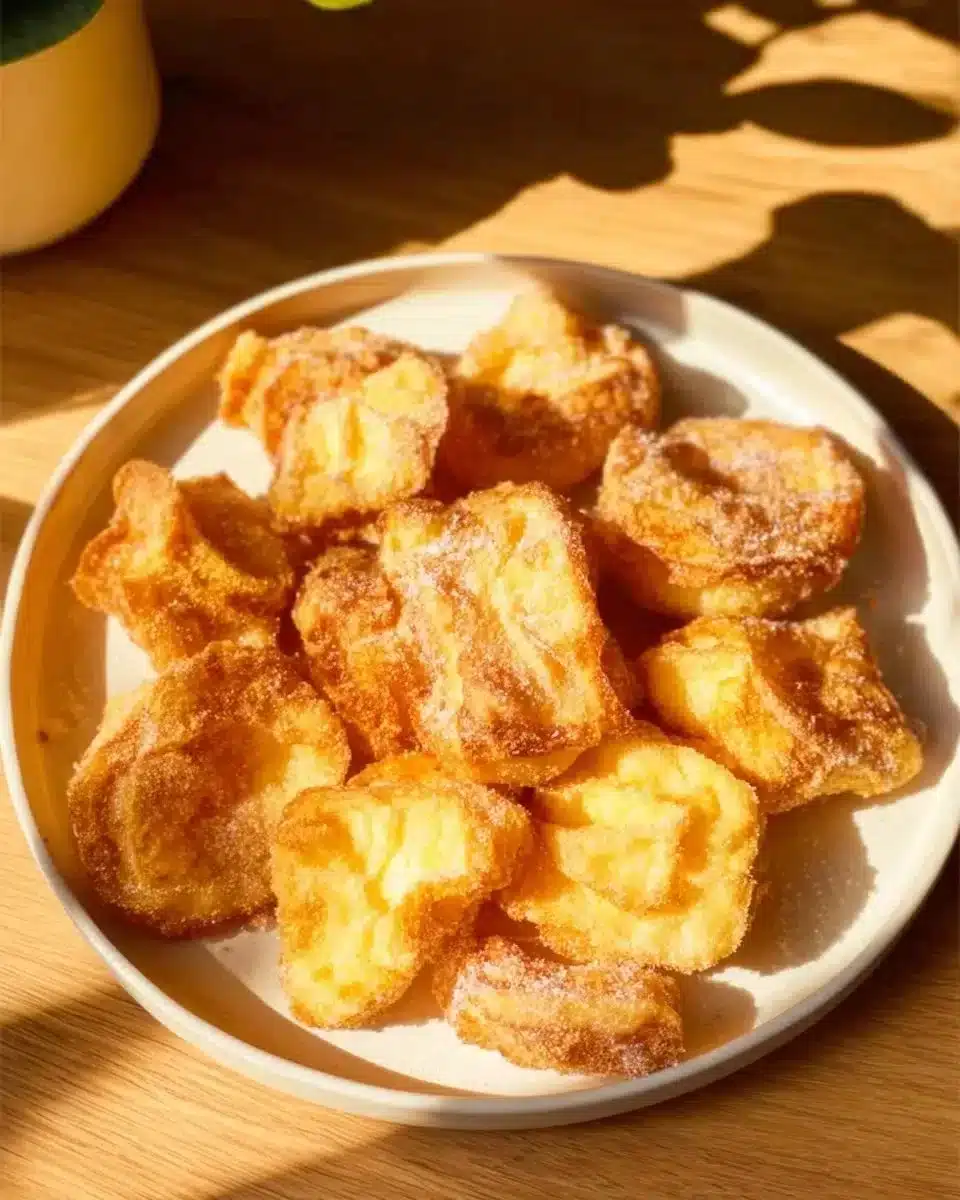
Fried Milk: Crispy Spanish Custard Recipe
The first bite should crack like thin glass, then give way to a warm, silky custard — that is the pleasure of Fried Milk. After testing this recipe eight times and tweaking the thickener ratios and chilling time, I landed on a version with a glossy, spoonable interior and a reliably crisp shell. This recipe traces to the streets and cafés of Spain where leche frita (literally “fried milk”) is a cherished treat. I perfected timing and coating techniques during years of recipe testing in a small test kitchen, so you won’t have to guess when the custard is set or the oil is hot enough. Read on for clear steps, exact weights and volumes, and the pro tricks I use to make sure each piece fries perfectly.
Why This Recipe Works
- The starch-to-milk ratio creates a custard that firms enough to cut but stays creamy inside.
- Cooling and pressing the custard removes steam pockets that cause splitting when frying.
- A thin flour dredge before the egg wash gives an even coating that adheres and crisps without soaking oil.
- Frying at a steady 175°C (350°F) browns quickly and minimizes oil absorption.
- A short rest after frying lets the crust set so sugar-cinnamon sticks without melting into the crust.
Ingredients Breakdown
- Whole milk — 1,000 ml (4 cups): Provides the richest mouthfeel. Skim or low-fat milk will yield a thinner custard.
- Granulated sugar — 100 g (½ cup): Sweetens the custard and helps with browning on the exterior. Reduce by 10–20 g for less sweetness.
- Cornstarch — 100 g (1 cup), weighed: The primary thickener; gives a smooth, glossy set. Do not substitute flour 1:1 or the texture will be grainy.
- All-purpose flour — 40 g (⅓ cup), weighed: Adds body and improves sliceability. For a gluten-free version, replace with an extra 100 g (1 cup) cornstarch and see Variations.
- Egg yolks — 2 large: Enrich the custard and add silkiness. If you prefer, pasteurized yolks work fine.
- Unsalted butter — 30 g (2 tbsp): Swirls in at the end for sheen and flavor. Use good-quality butter for best taste.
- Lemon peel (large strip) and 1 small cinnamon stick: Infuse gentle aromatic notes. Remove before chilling.
- Salt — 1/8 tsp (a pinch): Balances sweetness. Use Diamond Crystal kosher salt if possible; if using Morton’s, halve the measured volume.
- For coating: 100 g (¾ cup) all-purpose flour (weighed), 2 large eggs beaten, and 200 g (2 cups) plain fine breadcrumbs or panko (weighed). Panko gives a lighter, crunchier crust.
- Neutral frying oil (sunflower, canola, or peanut) — enough for 5 cm (2 in) depth in a pan: Choose a neutral oil with a smoke point above 190°C (375°F).
Internal note: If you like richer baked custards, try our baked pistachio custard pie for a different custard experience.
Essential Equipment
- Heavy-bottomed saucepan (2–3 L): Even heat prevents scorching the custard.
- Heatproof whisk and silicone spatula: For smooth mixing and scraping.
- 20×20 cm (8×8 inch) square baking pan or similar shallow dish: Use this size so the custard layer is not too thin. A deeper pan will increase chilling time.
- Plastic wrap, pressed directly on the surface to prevent a skin.
- Sharp knife and ruler (optional): For even pieces.
- Deep skillet or medium saucepan for frying (with a thermometer): A candy/deep-fry thermometer is the best way to hold 175°C (350°F).
- Slotted spoon or spider, and paper towels: For draining.
- Cooling rack over a sheet pan: Keeps fried pieces crisp while cooling.
- If you don’t have a thermometer: use a digital probe and a small metal skewer to test oil; a breadcrumb should sizzle immediately and brown within 45–60 seconds at the right temp.
For breadcrumb alternatives and frying tips, see our take on crisp coating techniques in the crispy oven-fried chicken guide.
Step-by-Step Instructions
Makes 8 servings. Prep time: 20 minutes. Cook time (active): 15 minutes. Inactive time (chill): 3 hours (or overnight). Total time: about 3 hours 35 minutes. Servings: 8 pieces; Serving size: 1 piece.
Step 1: Infuse the milk
Pour 1,000 ml (4 cups) whole milk into a heavy saucepan. Add the lemon peel and 1 small cinnamon stick, and bring to a gentle simmer over medium heat, whisking occasionally, for 3–5 minutes until fragrant. Remove from heat and let steep for 10 minutes.
Step 2: Combine dry ingredients
In a bowl, whisk together 100 g (1 cup) cornstarch, 40 g (⅓ cup) all-purpose flour, 100 g (½ cup) granulated sugar, and a pinch (1/8 tsp) salt until even. This prevents lumps and ensures a glossy finish. Do not skip sifting or whisking.
Step 3: Temper and thicken
Discard the lemon peel and cinnamon stick. Reserve 240 ml (1 cup) warm milk from the pan. Whisk the dry mix into the remaining hot milk in the saucepan until smooth. In a separate small bowl, beat 2 large egg yolks with the reserved 240 ml (1 cup) warm milk, then pour into the saucepan while whisking vigorously. Return to low-medium heat and cook, whisking constantly, for 6–8 minutes until the mixture thickens to a pudding-like consistency — it should coat the back of a spoon and show no raw flour bits. Do not let it boil hard — reduce heat if it bubbles too aggressively.
Step 4: Finish the custard
Off the heat, whisk in 30 g (2 tbsp) unsalted butter and 1 tsp vanilla extract. Taste and adjust sugar if needed. Transfer the custard to your 20×20 cm (8×8 in) baking pan and press plastic wrap directly onto the surface to prevent a skin. Smooth the top and refrigerate for at least 3 hours, or overnight, until fully firm.
Step 5: Cut and dredge
Turn the chilled custard onto a cutting board. Using a sharp knife, cut into eight 5×5 cm (2×2 in) squares or into 16 smaller squares for bite-size pieces. Lightly dust each piece in 100 g (¾ cup) flour, shake off excess, dip in 2 beaten eggs, then press into 200 g (2 cups) breadcrumbs until evenly coated. Work quickly: keep the pieces chilled on a tray between batches to prevent softening.
Step 6: Fry to golden
Heat oil to 175°C (350°F) in a deep skillet to a depth of about 5 cm (2 in). Fry the coated squares in batches for 1–1½ minutes per side until golden brown and crisp. Use a slotted spoon to turn pieces gently. Drain on paper towels, then transfer to a cooling rack for 2–3 minutes so the crust sets and becomes crackly.
Step 7: Sugar and serve
While warm, dust each piece with a mixture of 30 g (2 tbsp) granulated sugar and 1 tsp ground cinnamon. Serve within 15 minutes for the best contrast of crisp shell and warm custard center.
Expert Tips & Pro Techniques
- Chill long and press: Refrigerate until very firm and press the surface with plastic wrap to remove steam pockets that can cause spitting during frying.
- Avoid soggy coatings: Coat pieces in flour first — this creates a dry layer that helps the egg and breadcrumbs stick. Do not skip the flour step.
- Oil temperature matters: Keep the oil at 170–180°C (338–356°F). If too cool, pieces absorb oil; if too hot, the crust burns before the inside warms. Use a thermometer.
- Breadcrumb choice: Panko gives extra crunch; fine breadcrumbs yield a tighter crust. For a lighter result, flash-fry at higher temp (180°C/356°F) but shorten frying time by ~30 seconds per side.
- Make-ahead: You can complete the custard and chill it up to 48 hours in advance. Dredge and fry just before serving. This is ideal for entertaining.
- Common mistake & fix: If the custard is loose and cannot slice, you undercooked or used too little starch. Return mixture to low heat, whisk in another 1–2 tbsp cornstarch dissolved in cold milk, heat until thickened, then cool and chill again.
- Professional trick for even browning: Fry in a shallow pan rather than a deep fryer so you can watch the sides and flip at the exact moment the crust turns golden.
Storage & Reheating
- Refrigerator: Store fried pieces in a single layer in an airtight container lined with paper towel to absorb moisture. Keep for up to 2 days. Do not stack more than one layer.
- Freezer: Fried Milk is best fresh. You can freeze the uncooked, breadcrumbed pieces on a tray for up to 1 month, then transfer to a zip-top bag. Fry from frozen, adding 30–45 seconds per side. Texture will be slightly different.
- Reheating: Reheat in a 175°C (350°F) oven for 6–8 minutes on a rack to restore crispness. Avoid the microwave — it makes the crust soggy.
Variations & Substitutions
- Gluten-Free Version: Replace the 40 g all-purpose flour in the custard with 40 g extra cornstarch (so custard uses 140 g cornstarch total). For coating, use 150 g (1½ cups) rice flour for dredging and fine gluten-free breadcrumbs for the crust. Frying time is the same.
- Dairy-Free Version: Use 800 ml (3⅓ cups) full-fat coconut milk plus 200 ml (¾ cup + 2 tbsp) unsweetened oat milk for a creamy texture. Expect a faint coconut note and slightly firmer set; increase cornstarch to 120 g (1¼ cups).
- Eggless Coating: For an egg-free dredge, use a slurry of 80 g (⅓ cup) plain yogurt (or aquafaba) thinned with 2 tbsp water, then coat with breadcrumbs. The crust will be a touch less crisp but still satisfying.
- Cinnamon-Honey Glaze: After frying, brush warm pieces lightly with honey thinned with 1 tsp warm water and dust with cinnamon sugar for a glossy finish. Keep sugar dusting minimal to avoid melting into the crust.
For creative savory-sweet board ideas, try pairing small pieces with fruit compote and a dollop of mascarpone; for technique inspiration, see our apple dessert techniques that pair fruit acidity with creamy elements.
Serving Suggestions & Pairings
- Serve with a spoonful of orange marmalade or warmed fruit compote for brightness.
- Pair with a robust espresso or a glass of sweet Spanish sherry for classic regional contrast.
- Garnish with a sprig of mint and a dusting of extra cinnamon sugar.
- For a dessert plate, add a scoop of vanilla ice cream and toasted almonds.
If you want a contrasting main course for a tapas night, consider a hearty stew like our beef bourguignon as a balancing dish.
Nutrition Information
Per serving (1 piece). Recipe makes 8 servings.
- Calories: 260 kcal
- Total Fat: 9 g
- Saturated Fat: 4.5 g
- Cholesterol: 85 mg
- Sodium: 45 mg
- Total Carbohydrates: 35 g
- Dietary Fiber: 0.5 g
- Sugars: 20 g
- Protein: 5 g
Nutrition values are estimates. Actual values may vary based on specific ingredients and preparation methods.
Frequently Asked Questions
Q: Why did my custard turn out grainy?
A: Graininess usually means the starch didn’t hydrate properly or the mixture cooked unevenly. Whisk dry starch into a small amount of cold milk first, then add to hot milk. Cook slowly and whisk constantly until smooth.
Q: Can I make this without eggs?
A: Yes — you can omit egg yolks in the custard (use extra cornstarch) and replace the egg wash with aquafaba or yogurt for coating. The texture will be slightly different but still tasty.
Q: Can I double this recipe?
A: Yes, double the ingredients and use a larger baking pan so the custard layer thickness remains similar. Chill time may increase slightly; make sure it’s very firm before cutting.
Q: Can I prepare this the night before?
A: Absolutely. Make the custard, chill overnight, then dredge and fry just before serving for maximum crispness.
Q: How long does this keep in the fridge?
A: Fried pieces keep well for up to 2 days in the refrigerator in a single layer in an airtight container. Re-crisp in a 175°C (350°F) oven for best results.
Q: Why did my pieces absorb a lot of oil?
A: Oil absorption happens when the oil temperature is too low or if the coating is wet. Maintain 175°C (350°F) and make sure the pieces are well-chilled and lightly dusted in flour before egg and breadcrumbs.
Q: Can I use a deep fryer instead of a pan?
A: Yes. A deep fryer set to 175°C (350°F) works well for consistent temperature and even browning.
Conclusion
Leche frita is a simple dessert that rewards careful technique: a well-set custard, chilled and coated correctly, plus steady frying temperature. For a similar Spanish-inspired fried-sweet technique, check the torrijas variation explained in the Torrijas Caramelizadas Recipe – French Toast – Serious Eats. If you prefer watching a step-by-step video of leche frita being made, this clear demonstration is very helpful: How to Make Fried Milk – Spanish Leche Frita Recipe [Video].
Enjoy the crack, the cream, and the warm cinnamon-sugar finish.
Print
Fried Milk: Crispy Spanish Custard
- Total Time: 215 minutes
- Yield: 8 servings 1x
- Diet: Vegetarian
Description
Experience the delightful contrast of a crispy shell and warm, silky custard with this traditional Spanish dessert, leche frita.
Ingredients
- 1,000 ml (4 cups) whole milk
- 100 g (½ cup) granulated sugar
- 100 g (1 cup) cornstarch
- 40 g (⅓ cup) all-purpose flour
- 2 large egg yolks
- 30 g (2 tbsp) unsalted butter
- 1 large strip lemon peel
- 1 small cinnamon stick
- 1/8 tsp salt
- 100 g (¾ cup) all-purpose flour (for coating)
- 2 large eggs, beaten (for coating)
- 200 g (2 cups) plain fine breadcrumbs or panko (for coating)
- Neutral frying oil (enough for 5 cm depth)
Instructions
- Pour 1,000 ml whole milk into a saucepan. Add lemon peel and cinnamon stick, bringing to a gentle simmer for 3–5 minutes. Remove from heat and let steep for 10 minutes.
- In a bowl, whisk together cornstarch, all-purpose flour, granulated sugar, and salt until even.
- Discard lemon peel and cinnamon stick; reserve 240 ml warm milk. Whisk dry mix into hot milk until smooth. In another bowl, beat egg yolks with reserved milk, then pour into saucepan while whisking. Cook for 6–8 minutes until thick.
- Off the heat, whisk in butter and adjust sugar if needed. Transfer custard to a baking pan and press plastic wrap onto surface. Refrigerate for at least 3 hours.
- Turn the chilled custard onto a cutting board and cut into squares. Dredge each piece in flour, dip in beaten eggs, and coat with breadcrumbs.
- Heat oil to 175°C (350°F) in a skillet. Fry the squares in batches for 1–1½ minutes per side until golden brown. Drain on paper towels.
- Dust each piece with a mixture of sugar and cinnamon while warm. Serve immediately for the best texture.
Notes
For gluten-free, replace all-purpose flour with extra cornstarch; for dairy-free, use coconut milk and oat milk. Serve with marmalade or fruit compote for added flavor.
- Prep Time: 20 minutes
- Cook Time: 15 minutes
- Category: Dessert
- Method: Frying
- Cuisine: Spanish
Nutrition
- Serving Size: 1 piece
- Calories: 260
- Sugar: 20g
- Sodium: 45mg
- Fat: 9g
- Saturated Fat: 4.5g
- Unsaturated Fat: 4g
- Trans Fat: 0g
- Carbohydrates: 35g
- Fiber: 0.5g
- Protein: 5g
- Cholesterol: 85mg